Adaptogenic Drinks Instead of Alcohol: Where the Beer Option Fits
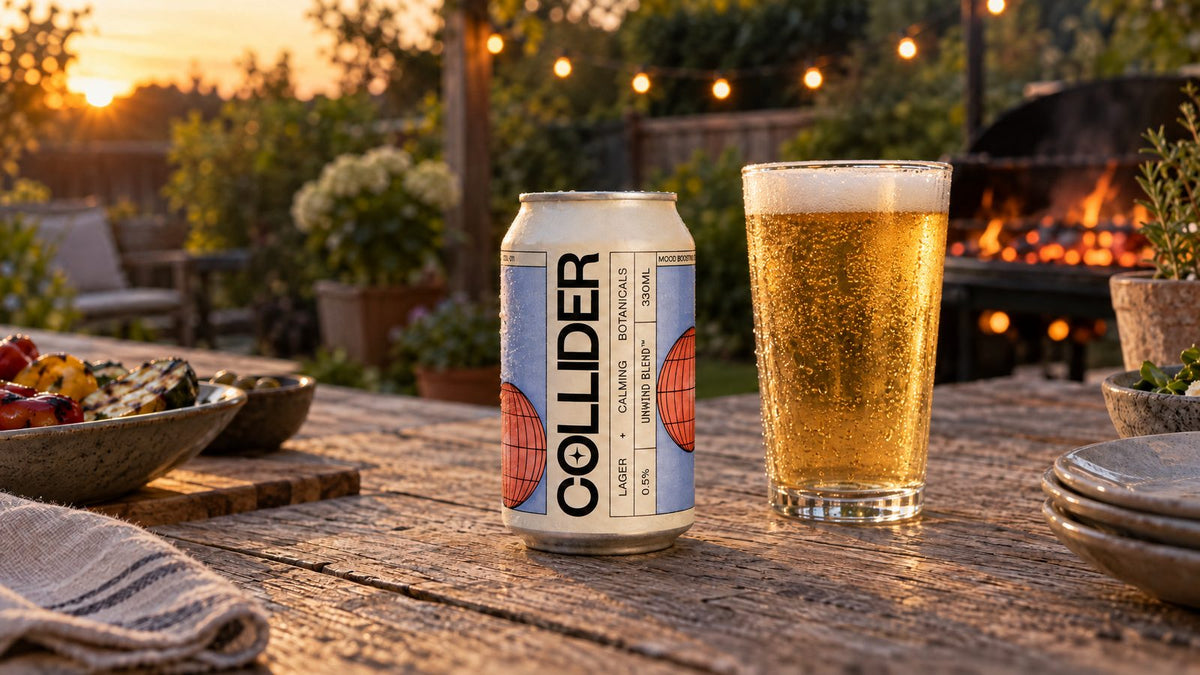
Search for adaptogenic drinks instead of alcohol and you will find elixirs, aperitifs and sparkling tonics. What you will struggle to find is a beer.
That matters. A lot of people cutting down do not miss alcohol so much as they miss beer: the cold can, the pour, the first sip at the end of the day. This guide covers what adaptogenic drinks are, the four formats you can choose from, what the research on the ingredients actually shows, and where a functional beer fits.
Full transparency: we make Collider, a non-alcoholic beer brewed with adaptogens. We have checked every fact about other brands against their own websites, and linked every study so you can read it yourself.
What are adaptogenic drinks?
Adaptogenic drinks are non-alcoholic drinks made with adaptogens: plants and mushrooms, such as Ashwagandha, that are studied for their effects on stress. Many also add a nootropic such as L-Theanine. They are made to replace the evening drink, not to get you drunk.
The term "adaptogen" was first used to describe substances that raise the body's "non-specific resistance" to stress (Panossian and Wikman, 2010). The names you will see most often on labels are Ashwagandha, rhodiola, reishi and Lion's Mane. L-Theanine, an amino acid found in tea, is usually called a nootropic rather than an adaptogen, but it often turns up alongside them.
The four kinds of adaptogenic drink you can swap for alcohol
Most adaptogenic drinks fall into four formats. The ingredients overlap a lot. The real difference is which drink each one is built to replace.
| Format | Example | How you drink it | Built to replace | Is it a beer? |
|---|---|---|---|---|
| Botanical elixir | Three Spirit | A 50 to 60ml measure from a 50cl bottle, topped up with tonic or soda | A spirit and mixer | No |
| Non-alcoholic aperitif | De Soi | From a can, or a bottle to mix | An aperitif or spritz | No |
| Social tonic | Hiyo | A fruit-flavoured sparkling can | A seltzer | No |
| Functional non-alcoholic beer | Collider | A cold can, or poured into a glass | A beer | Yes |
1. Botanical elixirs

Built for people who miss a spirit and mixer. Three Spirit sells non-alcoholic botanical elixirs in 50cl bottles, and its own recipes use a 50 to 60ml measure topped up with tonic or soda, or mixed into a cocktail. It is a cocktail-style ritual, not a beer.
2. Non-alcoholic aperitifs

Built around the aperitivo hour. De Soi describes its drinks as non-alcoholic aperitifs made with adaptogens, sold in cans and bottles. It is a spritz-style drink, not a beer.
3. Social tonics
Built to sit somewhere between a soft drink and a cocktail. Hiyo calls its cans "social tonics": fruit-flavoured, sparkling and 0% ABV, with adaptogens, nootropics and botanicals. It is a flavoured sparkling drink, not a beer.
4. Functional non-alcoholic beer

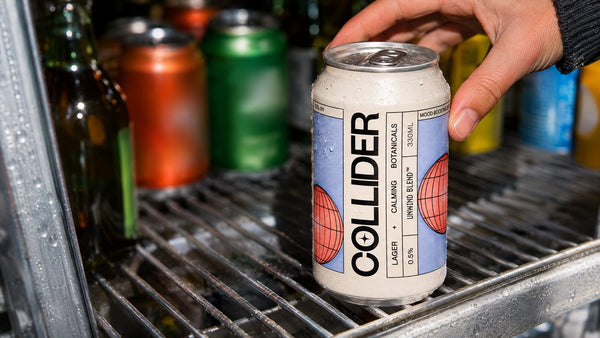
Brewed beer, under 0.5% ABV, with a functional blend added. It is the only one of the four formats that is actually beer, so it is the only one that fills a beer-shaped gap without asking you to change the habit. Collider is a UK example, with Lion's Mane, Ashwagandha and L-Theanine in every can.
Where the beer option fits
If what you miss is beer itself, a functional beer is the swap that changes the least. Same can. Same fridge. Same pub table, barbecue or match on the telly. You are not learning to love a new drink. You are keeping the one you already love and leaving the alcohol out.
> Key insight: Most adaptogenic drinks ask you to change your drink. A functional beer lets you keep it, and changes what is inside.
Collider at a glance:
- Real beer styles: Lager, Session IPA and Peach Lager. The Session IPA won Best in Class (96 points) at the London Beer Awards.
- Under 0.5% ABV, so it will not get you drunk. (Why, and what it means for driving.)
- 36 calories in a 330ml can of the Lager.
- The Unwind Blend™: 400mg per can, made up of 150mg L-Theanine, 150mg Ashwagandha and 100mg Lion's Mane.
- 4.8/5 from 817 on-site reviews.
The easiest way to find out if it fits your evenings is to try a few. Start with the Bestseller Pack: 24 cans for £57, with a 30-day money-back guarantee.
Collider vs the other UK functional beer

Impossibrew is the other well-known UK functional beer. On the two numbers that matter most for an adaptogenic beer, here is how they compare:
| Collider | Impossibrew | |
|---|---|---|
| Functional blend per can | 400mg Unwind Blend™ | 375mg Social Blend™ |
| Lion's Mane | Yes, 100mg in every can | None |
For the full side by side, read Collider vs Impossibrew: an honest comparison.
Will an adaptogenic drink give you a buzz?
These are the questions people ask most when they look for adaptogenic drinks instead of alcohol. Here are straight answers.
What will give me a buzz instead of alcohol?
No adaptogenic drink recreates the intoxication of alcohol, and any brand that promises it is overselling. What these drinks can offer is a gentler unwind: a cold drink, a ritual that marks the end of the day, and ingredients studied for stress. For many people cutting down, that unwind was what they were really after.
What drink will give you a buzz without alcohol?
If "buzz" means feeling drunk, none of them will. If it means the exhale at the end of the day, a functional drink inside a familiar ritual gets you closest. For beer drinkers, a functional non-alcoholic beer keeps the whole ritual, from the fridge to the glass, with adaptogens in place of alcohol. We go deeper in can an alcohol-free beer give you a buzz?
Do adaptogen drinks give you a buzz?
Not the way alcohol does. The research on these ingredients measures things like stress scores and cortisol over weeks of daily use, not a hit from one drink. People who do notice something tend to describe a gentle settling. In our own customer feedback, over 70% say they feel an effect, from mild to pronounced. That is self-reported and varies from person to person, and two cans seems to be the sweet spot.
What the research says about the ingredients
Here is the evidence for each ingredient in a can of Collider, strongest first.
Ashwagandha: strong evidence on stress
Ashwagandha has two randomised, double-blind, placebo-controlled trials behind it. In the first, 64 adults with a history of chronic stress took 600mg of Ashwagandha root extract a day for 60 days. Their scores on every stress scale, and their levels of cortisol (the body's main stress hormone), fell significantly compared with placebo (Chandrasekhar et al., 2012).
In the second, 60 adults with high stress took 240mg a day for 60 days. They saw bigger falls in anxiety scores and morning cortisol than the placebo group (Lopresti et al., 2019).
L-Theanine: randomised trial evidence
L-Theanine is an amino acid found in tea. In a four-week randomised, double-blind, placebo-controlled trial, 30 healthy adults took 200mg a day. Their scores for stress-related symptoms, including anxiety and sleep quality, improved over the four weeks, and the improvements in sleep were significantly better than placebo (Hidese et al., 2019).
Lion's Mane: emerging research
Lion's Mane is an edible mushroom, and the human research on it is early. In one small study, 30 women ate cookies containing Lion's Mane or a placebo for four weeks. Their scores on a low-mood questionnaire and a general complaints index fell after Lion's Mane, but most of the differences against placebo were not significant (Nagano et al., 2010). Interesting, not settled. More in Lion's Mane in beer: what the science actually says.
The dose question
To be straight with you: those trials used daily doses taken for four weeks to two months. That meant 240mg to 600mg of Ashwagandha, and 200mg of L-Theanine. A can of Collider contains 150mg of each, plus 100mg of Lion's Mane. So enjoy it as a great-tasting beer with a possible gentle lift, not as a supplement. Nothing here means Collider treats, prevents or cures anything.
Is the beer option right for you?
A functional beer is the right adaptogenic drink instead of alcohol if:
- You miss beer itself, not just "a drink".
- You want something that fits the pub, the barbecue or the sofa without explaining it to anyone.
- You like knowing exactly what is in the can, down to the milligram.
- You want the evidence linked, not just promised.
FAQs
What are adaptogenic drinks? Non-alcoholic drinks made with adaptogens such as Ashwagandha, often alongside nootropics such as L-Theanine. They come as botanical elixirs, aperitifs, sparkling tonics and functional beers, and they are designed to replace an alcoholic drink rather than intoxicate you.
Is there an adaptogenic beer?
Yes. Functional non-alcoholic beers add adaptogens to brewed beer under 0.5% ABV. Collider's Unwind Blend™ has 400mg per can: 150mg L-Theanine, 150mg Ashwagandha and 100mg Lion's Mane, across a Lager, a Session IPA and a Peach Lager.
Are adaptogenic drinks a good alternative to alcohol? They can be, if your expectations are realistic. They will not make you drunk. Ashwagandha and L-Theanine have randomised trial evidence on stress, Lion's Mane research is emerging, and the trials use supplement doses over weeks. The ritual of a familiar drink does a lot of the work too.
Which adaptogenic drink is most like beer? A functional non-alcoholic beer, because it is beer. Elixirs, aperitifs and tonics are built to replace spirits, spritzes and seltzers. Collider is brewed as a Lager, a Session IPA and a Peach Lager, with the Unwind Blend™ in every can.
Who should avoid adaptogenic drinks? Collider is not recommended if you are pregnant or breastfeeding, so speak to your GP first. If you take medication or have a health condition, check with a healthcare professional before trying any adaptogen. Nothing here is medical advice.
How many should I drink? Our customer feedback points to two cans as the sweet spot, with the effect levelling off after two or three. There is no benefit to overdoing it.
Collider is non-alcoholic craft beer brewed with the Unwind Blend™: Lion's Mane, Ashwagandha and L-Theanine. Try the Bestseller Pack: 24 cans for £57, with a 30-day money-back guarantee →
Studies: Panossian A, Wikman G (2010), Pharmaceuticals, doi:10.3390/ph3010188. Chandrasekhar K, Kapoor J, Anishetty S (2012), Indian Journal of Psychological Medicine, doi:10.4103/0253-7176.106022. Lopresti AL et al. (2019), Medicine, doi:10.1097/MD.0000000000017186. Hidese S et al. (2019), Nutrients, doi:10.3390/nu11102362. Nagano M et al. (2010), Biomedical Research, doi:10.2220/biomedres.31.231. Details about other brands were checked on each brand's own website on 27 October 2026. Ingredient studies use supplement doses; nothing here is medical advice or a health claim about Collider.
Try Collider for yourself with the Bestseller Pack, backed by a 30 day money-back guarantee.
Get the Bestseller Pack