


Lion's Mane in beer: what the science actually says
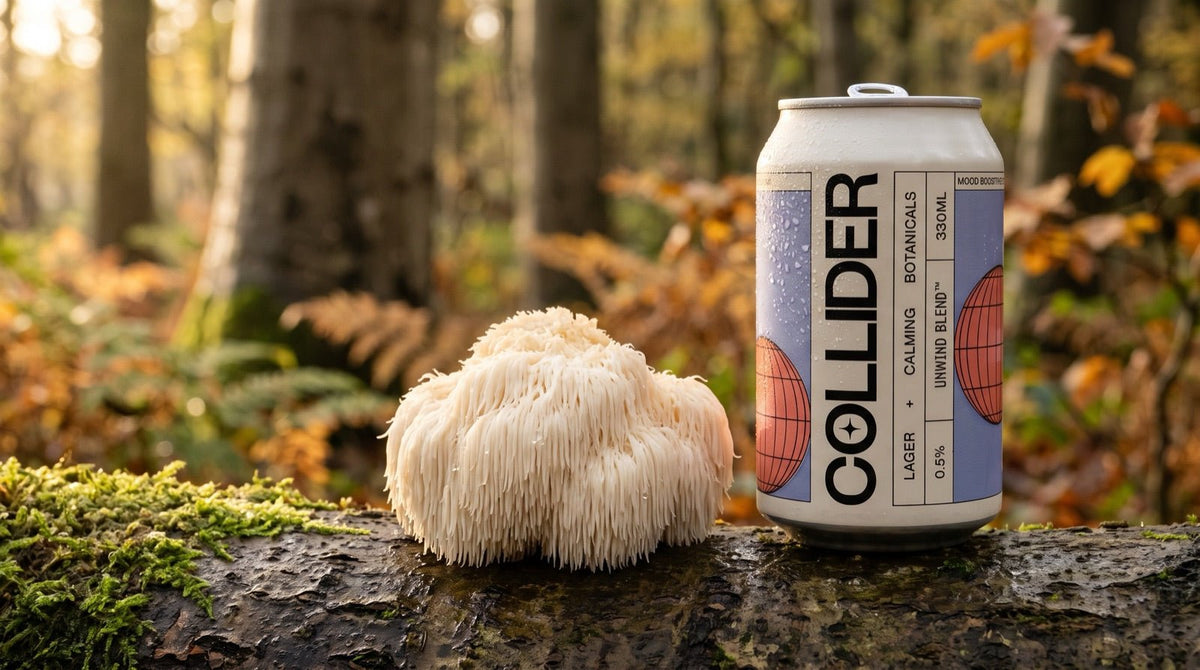
A few years ago, "functional mushroom" meant a powder you stirred into your coffee. Now it's turning up in beer, specifically non-alcoholic beer. Collider puts Lion's Mane in every can, alongside two other functional ingredients. So what is it, why would anyone brew it into a beer, and does the science back it up? That last question is the one that matters.
Here's the honest version, with the studies linked so you can check them yourself.
What is Lion's Mane?
Lion's Mane (Hericium erinaceus) is an edible mushroom: the shaggy, white, cascading one that genuinely looks like a lion's mane. It's been used in East Asian food and traditional medicine for centuries, and in the last two decades it's become one of the most-studied "nootropic" mushrooms, mostly for its potential effects on the brain.
It's worth being clear up front: the research is early. Promising in places, but small, and often done with concentrated extracts rather than the amount you'd get in a drink. We'll show you exactly where the evidence is strong and where it's thin.
Why put a mushroom in beer at all?
Two reasons, one honest admission.
- The category is changing. Non-alcoholic beer used to be about what it removed: the alcohol, the hangover, the calories. The newer wave is about what it can add: a more interesting drink for the evening wind-down that alcohol used to own. Functional ingredients are how brands try to do that.
- Lion's Mane is a beer-friendly idea. Beer already has a mushroom-adjacent, earthy, umami side to it. A functional mushroom isn't the stretch it sounds.
- The admission: a can of beer is not a supplement. Most of the studies below use far higher doses than any beer realistically contains. So the right expectation is "an enjoyable alcohol-free beer that happens to contain an ingredient researchers find interesting", not "a cognitive enhancer in a can."
What the research shows on Lion's Mane
Cognition: promising but preliminary. The most-cited human study is a small 2009 Japanese randomised, double-blind, placebo-controlled trial. Thirty adults aged 50 to 80 with mild cognitive impairment took 3,000 mg/day of Lion's Mane powder for 16 weeks and scored better on a cognitive scale than the placebo group. But the benefit faded once they stopped (Mori et al., 2009).
What that does not prove: that Lion's Mane sharpens focus in healthy people, or that a beer-sized amount does anything measurable. It's one small study, in a clinical population, at a dose far above any drink. Genuinely interesting; nowhere near settled.
The nerve-growth-factor story: laboratory only. You'll often see Lion's Mane linked to "nerve growth factor" (NGF), a protein involved in keeping neurons healthy. That comes from lab studies showing Lion's Mane extract stimulating NGF in cultured human cells (Mori et al., 2008). It's a real, intriguing mechanism. But it's a petri dish, not a person. No one has shown this happens in your brain from drinking it.
Our take: Lion's Mane is the most exciting ingredient in functional beer and the one with the least proven human evidence. Both things are true. We include it because we think it's a compelling, well-tolerated ingredient with a promising research direction, not because we can promise it'll make you smarter.
The supporting cast: Ashwagandha and L-Theanine
Lion's Mane rarely travels alone. In Collider's Unwind Blend™ it sits alongside two ingredients with stronger evidence for the relaxation side of the equation:
- Ashwagandha: an adaptogenic herb, and the best-evidenced of the three for stress. Two randomised, placebo-controlled trials found it reduced cortisol (the main stress hormone) and stress scores (Chandrasekhar et al., 2012; Lopresti et al., 2019). Again, these used supplement doses and modest sample sizes, but two independent trials agreeing is as good as this category's evidence gets.
- L-Theanine: the amino acid that makes green tea feel calm-but-alert rather than jittery. It's been shown to increase alpha brain-wave activity, a marker of relaxed focus, without causing drowsiness (Nobre et al., 2008), and to reduce stress-related symptoms over four weeks (Hidese et al., 2019).
Together the idea is simple: an evening beer that might help you feel a little calmer, without the alcohol. The honest caveat applies to all three: effects are studied at higher doses, and they vary a lot between people.
"Functional mushroom" vs "adaptogen" vs "nootropic": a quick decoder
These words get thrown around interchangeably. They're not the same:
- Functional mushroom: a mushroom eaten for a potential benefit beyond nutrition (e.g. Lion's Mane, reishi).
- Adaptogen: a plant or fungus thought to help the body cope with stress (e.g. ashwagandha). Lion's Mane is sometimes grouped here too.
- Nootropic: anything studied for a cognitive benefit (L-Theanine and Lion's Mane both get this label).
Lion's Mane manages to sit in all three buckets, which is part of why it's having a moment.
Will you actually feel anything?
Straight answer: maybe. In our own customer feedback, over 70% of people report feeling some sort of effect, ranging from mild to pronounced, and the people who do feel something tend to describe a gentle sense of calm rather than anything dramatic. Our honest guidance is "two cans is the sweet spot," and the effect seems to plateau after that. We'd rather tell you that than oversell it, because the fastest way to lose your trust is to promise a buzz and deliver a placebo.
If you do try it, treat it like any wellness habit: give it a fair run, pay attention to how you feel, and don't expect a supplement-strength hit from a beer.
FAQs
Does Lion's Mane in beer do anything? Lion's Mane has been studied for cognition, with early and limited human evidence, most of it at supplement doses well above what's in a beer. Think of it as an interesting ingredient in an enjoyable alcohol-free beer, not a cognitive supplement.
Is Lion's Mane safe to drink in beer? Lion's Mane is a widely eaten food mushroom and is generally well tolerated. As with any new ingredient, if you're pregnant, breastfeeding, on medication or have allergies, check with a healthcare professional. (This isn't medical advice.)
Will Lion's Mane beer get me high or give me a buzz? No. Functional mushrooms like Lion's Mane are not psychoactive. They're nothing like "magic" mushrooms. Any effect people describe is a subtle sense of calm or focus, and the beer itself is under 0.5% ABV.
What's the difference between Lion's Mane and ashwagandha? Lion's Mane is a functional mushroom studied mainly for cognition; ashwagandha is an adaptogenic herb with better evidence for reducing stress and cortisol. Collider's Unwind Blend™ uses both, plus L-Theanine.
Which beers contain Lion's Mane? Collider brews Lion's Mane (with Ashwagandha and L-Theanine) into every beer in its range: Lager, Session IPA and Peach Lager.
Collider is non-alcoholic craft beer made with the Unwind Blend™: Lion's Mane, Ashwagandha and L-Theanine. Try the Bestseller Pack →
Sources: Mori et al. 2009, Phytotherapy Research · Mori et al. 2008, Biological & Pharmaceutical Bulletin · Chandrasekhar et al. 2012, Indian Journal of Psychological Medicine · Lopresti et al. 2019, Medicine · Nobre et al. 2008, Asia Pacific Journal of Clinical Nutrition · Hidese et al. 2019, Nutrients. Ingredient research is early and uses supplement doses; nothing here is medical advice or a health claim about Collider.
Try Collider for yourself with the Bestseller Pack, backed by a 30 day money-back guarantee.
Get the Bestseller Pack