Zebra Striping: How to Pace Yourself on a Night Out
Zebra striping means alternating an alcoholic drink with a non-alcoholic one, so every other round carries little or no alcohol. Over a six-round night of 4% pints, it takes you from 13.6 units to 7.3 at most, close to half, and you never sit out a round. Here is how it works, with the numbers.
Party season is the hardest time of year to pace yourself. The rounds come faster, the nights run longer and there is always one more on offer. Zebra striping is the simplest pacing method we know, and UK health guidance backs the idea behind it.
What is zebra striping?
Zebra striping is a pacing method that alternates alcoholic and non-alcoholic drinks through a night out, like the black and white stripes on a zebra. You stay in every round, but half your drinks carry little or no alcohol.
It is not a fringe habit. According to Drinkaware (March 2025), a quarter of UK drinkers already zebra stripe when they go out to pubs and bars.
The official advice points the same way. The UK Chief Medical Officers' low risk drinking guidelines say that to keep the short-term risks of a single night low, you should limit the total you drink, drink more slowly, drink with food and alternate with water. The NHS tips on cutting down put it plainly: "Alternate alcoholic drinks with water or other non-alcoholic drinks."
A night out, round by round
The NHS uses one formula for alcohol units: strength (ABV %) x volume (ml) ÷ 1,000.
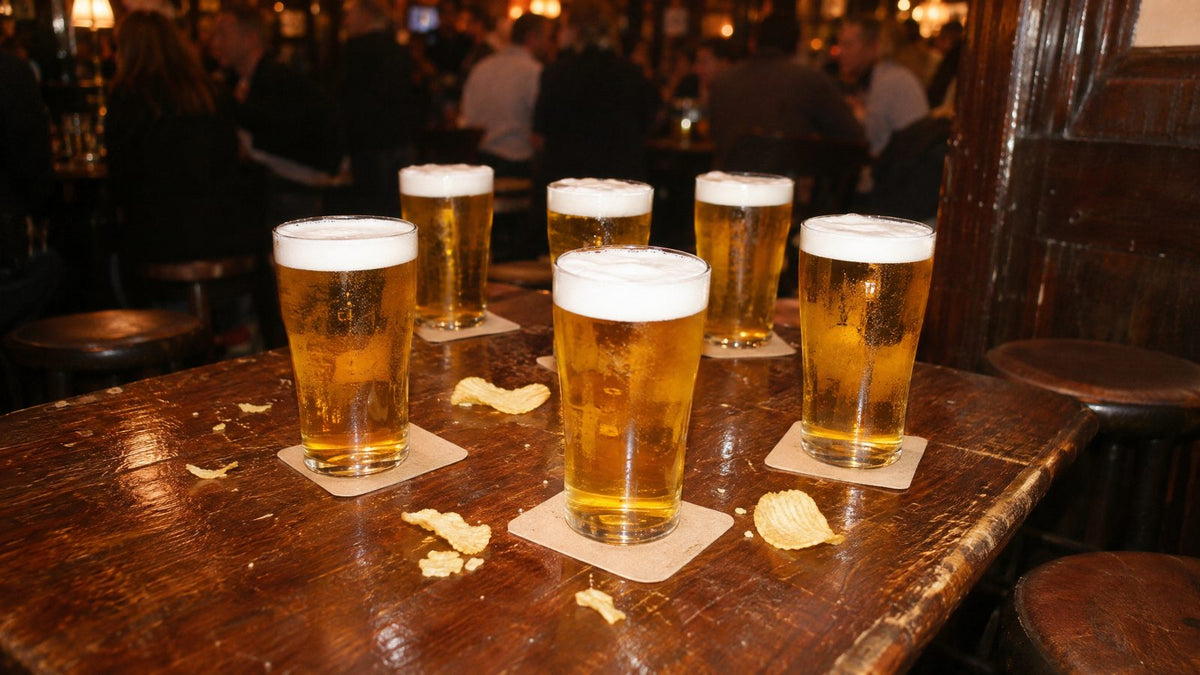
- A pint (568ml) of 4% lager: 4 x 568 ÷ 1,000 = 2.3 units.
- A 330ml can at 0.5% ABV: 0.5 x 330 ÷ 1,000 = 0.17 units. Collider is always under 0.5% ABV, so each can has less than that.
Here is the same six-round night, with and without stripes:
| Round | Without striping | Units so far | Zebra striped | Units so far |
|---|---|---|---|---|
| 1 | Pint of 4% lager | 2.3 | Pint of 4% lager | 2.3 |
| 2 | Pint of 4% lager | 4.5 | Can of Collider Lager | 2.4 |
| 3 | Pint of 4% lager | 6.8 | Pint of 4% lager | 4.7 |
| 4 | Pint of 4% lager | 9.1 | Can of Collider Session IPA | 4.9 |
| 5 | Pint of 4% lager | 11.4 | Pint of 4% lager | 7.1 |
| 6 | Pint of 4% lager | 13.6 | Can of Collider Lager | 7.3 |
We counted every Collider can at the 0.5% ceiling, so the striped total is a maximum, not an estimate.
> Key insight: Same six rounds, same seat at the table, at least 6.3 fewer units. Swapping every other pint takes out 46% or more of the night's alcohol.
Why that matters: the Chief Medical Officers advise not drinking more than 14 units a week on a regular basis, spread over three or more days. Six pints of 4% lager is 13.6 units, nearly a full week's guideline in one evening. They also warn that one or two heavy drinking episodes a week raise your risk of death from long-term illness and from accidents and injuries.
Striping brings that night down to 7.3 units at most. That is still half the weekly guideline, so plan the rest of your week around it, with several drink-free days.
Why your alternate should taste like a pint
Water works, and the NHS recommends it. The catch is that a stripe only helps if you keep it up, and by round four a glass of tap water can feel like sitting out. Three things make the stripe stick:
- It looks like a pint. A beer in your hand means nobody asks why you are not drinking, and you stay in the round.
- It tastes like beer. If the alternate tastes like a compromise, the next round drifts back to the strong stuff.
- It replaces a drink rather than adding one. Six pints plus six non-alcoholic beers is still six pints. Keep the same number of rounds and swap half of them.
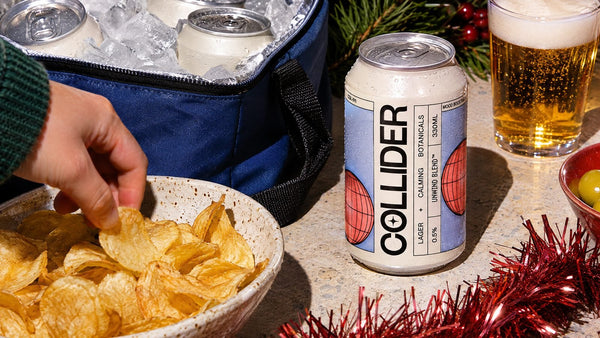
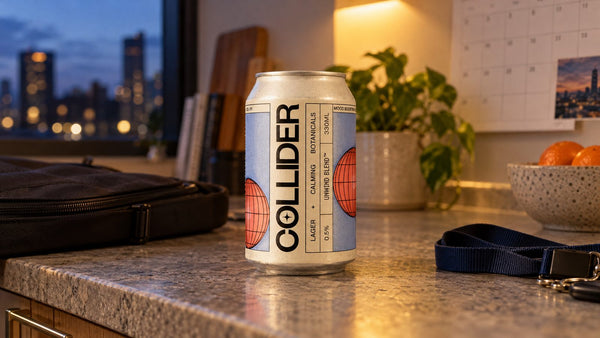
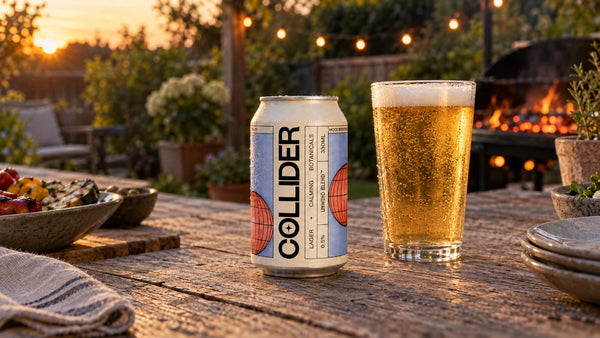
Collider is our beer, and we brewed it to be judged as beer first:
- Collider Session IPA won Best in Class with 96 points at the London Beer Awards. Citrus and stone fruit, with a dry, malty finish.

- Collider Lager is crisp, dry and malty, with 36 calories a can.

- Both are under 0.5% ABV, brewed as beer and never dealcoholised.
You can try both in the Bestseller Pack: 12 Lager and 12 Session IPA, 24 cans for £57, with a 30-day money-back guarantee.
What is the best non-alcoholic beer for socialising?
The best non-alcoholic beer for socialising is one that passes for a pint: full beer flavour, a proper head in the glass, and under 0.5% ABV so each can adds less than 0.17 units. Our pick is Collider Session IPA, Best in Class with 96 points at the London Beer Awards, with Collider Lager at 36 calories a can as the crisp option.
What to look for on a night out:
| What matters | Why it matters socially | Collider |
|---|---|---|
| Tastes like beer | You will actually want the next one | Session IPA: Best in Class, 96 points, London Beer Awards |
| Under 0.5% ABV | Less than 0.17 units a can | Lager and Session IPA, always under 0.5% ABV |
| Light over a long night | You might have three or four | Lager: 36 calories a can |
| Easy to bring along | House parties and the match at a mate's | 330ml cans, 24 to a box |
What are the best drinks to help you cut down on alcohol?
The best drinks for cutting down are the ones that replace an alcoholic drink without changing your night. If you drink pints, that is a non-alcoholic beer under 0.5% ABV. Between rounds, water or a soft drink. When you do drink alcohol, smaller or lower-strength drinks. The NHS recommends all of these.
Here is what each swap saves against one pint of 4% lager (2.27 units), using the NHS formula:
| Swap | Units in the swap | Units saved |
|---|---|---|
| Water or a soft drink | 0 | 2.27 |
| 330ml can of non-alcoholic beer, under 0.5% ABV | under 0.17 | over 2.10 |
| 330ml bottle of 5% beer instead of a pint | 1.65 | 0.62 |
| Pint of 3.6% lower-strength lager | 2.04 | 0.23 |
A non-alcoholic beer saves almost as much as water and keeps the pint in your hand. Smaller and weaker drinks help, but far less per round.
The wider evidence points the same way. A study of 64,286 British households found that the arrival of new low and no alcohol beers, alongside lower-strength recipes for existing beers, was linked to households buying 2.6% to 3.9% less alcohol overall (Anderson et al., BMJ Open, 2020). That is an association, not proof, and it rests on one rule: the swap has to take the place of an alcoholic drink.
How to zebra stripe on a night out
- Pick your number before you go. The NHS advice is to set a limit on how much you are going to drink before you start.
- Eat first and open with a stripe. The NHS suggests eating and having a glass of water before you have any alcohol.
- Keep the glass the same. Pour your non-alcoholic beer into a pint glass and nobody will look twice.
- Recruit a friend. The NHS notes that telling friends you are cutting down gets you support. Two people striping is easier than one.
- Bring your own to house parties. Take a box of cans so the stripe is always in the fridge.
- Plan the way home. The Chief Medical Officers advise planning ahead, such as making sure you can get home safely.
- Mind the week, not just the night. Keep to 14 units a week or less, spread over three or more days, with several drink-free days.
Does zebra striping stop a hangover?
Nobody can promise that it will. The popular idea is that water between drinks rehydrates you and stops the hangover, but the research does not back it.
A 2024 review in the journal Alcohol found that water during or straight after drinking had only a modest effect on preventing a next-day hangover, and water drunk during a hangover did not ease it. The authors concluded that dehydration and hangover are two separate after-effects of alcohol (Mackus et al., 2024). A small 2026 crossover trial in 13 men found that water chasers made no difference to next-day symptoms (Imai et al., 2026).
So the part of zebra striping that counts is the alcohol you skip, not the water you add. That is why the alternate matters.
What is the 3:2:1 rule for drinking?
There is no official 3:2:1 rule for drinking. It is an informal rule of thumb shared online, and the versions do not agree: some cap the number of drinks, others are about spacing drinks before bed. It is not part of NHS advice or the UK Chief Medical Officers' guidelines.
The guideline they do use is simpler: no more than 14 units a week on a regular basis, spread over three or more days, with several drink-free days.
Frequently asked questions
How many units are in a pint of lager?
It depends on the strength. A pint of 4% lager is 2.3 units. The NHS puts a pint of lower-strength 3.6% lager at 2 units and a pint of 5.2% lager at 3 units.
How many units are in a can of non-alcoholic beer?
A 330ml can at 0.5% ABV has 0.17 units (0.5 x 330 ÷ 1,000). Collider is always under 0.5% ABV, so each can has less than that.
How many pints is 14 units?
The NHS says 14 units is about 6 pints of average-strength beer. Six pints of 4% lager comes to 13.6 units.
Should I zebra stripe with water or non-alcoholic beer?
Either takes nearly all the alcohol out of that round. Water is free and the NHS recommends it. A non-alcoholic beer keeps the taste and the pint in your hand, which makes the stripe easier to keep up all night.
Does zebra striping mean I can drink for longer?
No. It is a way to drink less, not a reason to drink more. If six pints become six pints plus six alternates, the alcohol has not changed. Keep the same number of rounds and swap half of them.
Does zebra striping work at a Christmas party?
Yes, and it is where it helps most. Rounds come quickly and nights run late. Ask the bar for a non-alcoholic beer, or bring a few cans to a house party so there is always a stripe on hand.
Stock up on stripes for party season

The easiest stripe is the one already in your fridge. The Bestseller Pack is 24 cans, 12 Collider Lager and 12 Collider Session IPA, for £57. If you do not like it, our 30-day money-back guarantee has you covered.
Sources
- Drinkaware. What is zebra striping and why is it becoming popular? Published 11 March 2025.
- UK Chief Medical Officers. UK Chief Medical Officers' Low Risk Drinking Guidelines. Department of Health, August 2016.
- NHS. Alcohol units. Last reviewed 27 August 2024.
- NHS. Tips on cutting down on alcohol. Last reviewed 9 April 2026.
- Anderson P, Jané Llopis E, O'Donnell A, Manthey J, Rehm J. Impact of low and no alcohol beers on purchases of alcohol: interrupted time series analysis of British household shopping data, 2015 to 2018. BMJ Open. 2020;10(10):e036371. doi:10.1136/bmjopen-2019-036371
- Mackus M, Stock AK, Garssen J, Scholey A, Verster JC. Alcohol hangover versus dehydration revisited: the effect of drinking water to prevent or alleviate the alcohol hangover. Alcohol. 2024;121:9 to 18. doi:10.1016/j.alcohol.2024.07.006
- Imai H, Kushio S, Matsuura K, et al. Water intake during drinking does not alleviate hangover symptoms. Frontiers in Pharmacology. 2026;17:1852528. doi:10.3389/fphar.2026.1852528
Try Collider for yourself with the Bestseller Pack, backed by a 30 day money-back guarantee.
Get the Bestseller Pack