

Can You Drink Non-Alcoholic Beer Every Day?

A beer most evenings is a habit plenty of us would rather keep. The hangover, the units and the 3am wake-ups are the parts we would happily lose. So can you swap in a non-alcoholic beer and have one every single day?
For most healthy adults, yes. Below you will find the short answer, the numbers behind it, what the studies say, and the few people who should check first. Every study is linked so you can read it yourself.
Can you drink non-alcoholic beer every day?
Yes. For most healthy adults, a non-alcoholic beer every day is fine. A 330ml can at 0.5% ABV holds at most about 1.3g of alcohol, roughly what is in 100g of some packaged bread rolls. In one German study, people who drank 2.5 litres had no measurable alcohol in their blood. Just check the calories and any added ingredients.
What is non-alcoholic beer?
Non-alcoholic beer is beer brewed with the alcohol removed or kept very low, usually to 0.5% ABV or less. At that strength your body clears the trace of alcohol as fast as you drink it, so it will not get you drunk or leave you with a hangover.
UK labels use a few different terms for this, from "alcohol-free" to "de-alcoholised". We explain each one in our guide: does non-alcoholic beer get you drunk?
How much alcohol is in a daily non-alcoholic beer?
Very little. Here is the working for a 330ml can at the 0.5% limit:
- 330ml x 0.5% = 1.65ml of alcohol
- 1.65ml x 0.79g per ml = about 1.3g of alcohol
- In UK units: 330 x 0.5 / 1,000 = 0.165, so under 0.17 units a can
That trace sits in the same range as everyday food. A 2016 study in the Journal of Analytical Toxicology found that some packaged burger rolls and sweet milk rolls held more than 1.2g of alcohol per 100g. Orange, apple and grape juice held up to 0.77g per litre.
Blood tests back this up. In a 2010 study from the Institute of Forensic Medicine at Freiburg University, volunteers each drank 2.5 litres of German "alcohol-free" beer, which is allowed up to 0.5% alcohol. That is more than seven 330ml cans. Alcohol in their blood and urine samples tested negative.
> Key insight: With a daily non-alcoholic beer, the alcohol is the least of it. The numbers worth checking are the calories per can and anything added to the recipe.
A can a night for a week: 5% lager vs Collider
Here is what one 330ml can every evening adds up to over seven days.
| One 330ml can every night | 5% lager | Collider Lager |
|---|---|---|
| Alcohol per can | about 13g | under 1.3g |
| UK units over 7 days | 11.6 | under 1.2 |
| Calories over 7 days | over 637 (from the alcohol alone) | 252 |
| Hangover the next morning | possible | no |
How we worked it out:
- 5% lager alcohol: 330ml x 5% = 16.5ml of alcohol, or about 13g at 0.79g per ml.
- 5% lager calories: alcohol carries 7 calories per gram under UK food labelling rules (Regulation (EU) No 1169/2011, Annex XIV). So 13g is about 91 calories a can before any malt carbohydrate, and 91 x 7 = 637 a week.
- Units: 330 x 5 / 1,000 = 1.65 a can, and 1.65 x 7 = 11.55, which rounds to 11.6.
- Collider Lager: 36 calories a can, and 36 x 7 = 252 a week.
The UK Chief Medical Officers' low risk drinking guidelines say it is safest not to drink more than 14 units a week on a regular basis. If you want to cut down, they suggest several drink-free days each week.
A 5% can every night comes in under 14 units, but it leaves you no drink-free days at all. Make it a pint (568ml) and you are at 2.84 units a night, or 19.9 a week (568 x 5 / 1,000 x 7), which is over the guideline. A Collider every night keeps the whole week under 1.2 units.
Why the nightly swap matters for sleep
Alcohol is a sleep trick that backfires. A 2013 review of every known study on alcohol and sleep in healthy volunteers found that at all doses, alcohol helps you fall asleep faster but increases disrupted sleep in the second half of the night. It also delays your first spell of REM (dreaming) sleep.
That is the 3am wake-up many regular drinkers know well. Swapping your evening beer for a non-alcoholic one takes almost all of that alcohol out of the evening.
What happened when people drank non-alcoholic beer every day?
Researchers have tested non-alcoholic beer as a daily drink, for weeks at a time. The groups were small or specific, so treat these as interesting findings rather than proof.
- Nurses on shift work. In a 2012 study in PLOS ONE, 17 healthy female nurses drank one 333ml non-alcoholic beer (0.0% alcohol, with hops) with supper for 14 days. Wrist activity monitors showed they fell asleep in about 12 minutes on average, against about 20.5 minutes on nights without it. Their anxiety questionnaire scores were also lower. There was no placebo drink, and the researchers credited the hops.
- Marathon runners. In a 2012 double-blind trial in Medicine and Science in Sports and Exercise, 277 healthy male runners drank 1 to 1.5 litres a day of non-alcoholic beer or a placebo drink. They did this for three weeks before and two weeks after the Munich Marathon. The beer group had lower inflammation markers straight after the race, and upper respiratory illness was 3.25 times less common in the two weeks that followed. The researchers put this down to the beer's polyphenols, natural plant compounds.
Neither study tested Collider or any functional beer. They tell you about non-alcoholic beer in general, and that people have drunk it daily, at up to 1.5 litres a day, for weeks at a time.
Can you drink a functional non-alcoholic beer every day?
Functional non-alcoholic beers add active ingredients to the recipe. Collider's Unwind Blend puts 400mg in every can: 150mg L-Theanine, 150mg Ashwagandha and 100mg Lion's Mane. All three have been studied as a daily habit, taken every day for weeks.
Ashwagandha: strong evidence
Ashwagandha is backed by double-blind, placebo-controlled trials. In a 2012 trial, 64 adults with chronic stress took 600mg of ashwagandha root extract a day (300mg twice daily) for 60 days. Their stress scores and cortisol, a stress hormone, fell significantly compared with placebo. Side effects were mild and similar in both groups, and no serious side effects were reported.
A 2019 trial of 60 stressed adults tested 250mg and 600mg a day for eight weeks. Both doses lowered perceived stress scores and cortisol, and sleep quality improved compared with placebo.
L-Theanine: strong evidence
L-Theanine is an amino acid found in tea. In a 2019 double-blind crossover trial, 30 healthy adults took 200mg a day or a placebo, each for four weeks. On L-Theanine, scores for stress-related symptoms fell. Compared with placebo, people also reported falling asleep faster and less disturbed sleep.
Lion's Mane: emerging research
Lion's Mane is a mushroom, and the research on it is newer. In a 2023 pilot trial at Northumbria University, 41 healthy adults aged 18 to 45 took 1.8g a day or a placebo for 28 days. A single dose made people quicker on a word and colour task (the Stroop test) an hour later. After 28 days there was a trend towards lower stress that just missed statistical significance, and the authors say the small study should be read with caution. More in Lion's Mane in beer: what the science actually says.
One can against the daily amounts in the trials
| Ingredient | In one can of Collider | Daily amount in the trial | Taken every day for |
|---|---|---|---|
| L-Theanine | 150mg | 200mg | 4 weeks |
| Ashwagandha | 150mg | 250mg to 600mg | 8 weeks to 60 days |
| Lion's Mane | 100mg | 1,800mg | 28 days |
One can a day sits below the daily amount used in every trial above. These trials tested supplements, not beer and not Collider, so they tell you how each ingredient has been studied, not what a can will do for you. Collider is built as a daily beer, not a supplement: a measured blend in a lager with 36 calories a can.
Who should check before drinking non-alcoholic beer every day?
A daily non-alcoholic beer suits most adults, but a few people should check first.
- Pregnant or breastfeeding. We don't recommend Collider if you're pregnant or breastfeeding: speak to your GP first. For any other non-alcoholic beer, ask your midwife or GP.
- On an alcohol monitoring programme. In the Freiburg study, drinking 2.5 litres of "alcohol-free" beer left alcohol breakdown markers in some volunteers' urine above the cut-off often used to prove abstinence. If you are tested for abstinence, for example to get a driving licence back or at work, check with whoever runs the testing first.
- In recovery from alcohol dependence. Talk to your support team before making any beer, even an alcohol-free one, a daily habit.
- Taking medicine or managing a health condition. Check with your GP or pharmacist before making any herbal ingredient, Ashwagandha included, part of your daily routine.
- Under 18. Non-alcoholic beer is made and sold for adults.
Where Collider fits a daily beer habit

If you want a beer every evening without the alcohol, here is what a can of Collider brings:
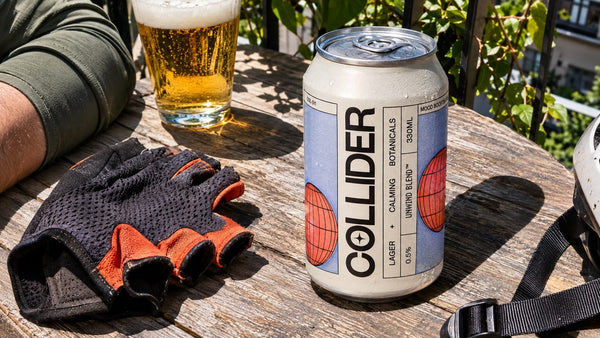
- 36 calories per 330ml can of Collider Lager
- Under 0.5% ABV, so no hangover the next morning
- 400mg Unwind Blend in every can: L-Theanine, Ashwagandha and Lion's Mane
- Gluten free: brewed with wheat and barley, with the gluten removed
- 4.8/5 from 817 on-site reviews
- From about £1.87 a can on subscription, so a can a night is about £13.09 a week (7 x £1.87)
Try the Bestseller Pack: 24 cans for £57, with a 30-day money-back guarantee.
Frequently asked questions
Is it OK to drink non-alcoholic beer every day?
For most healthy adults, yes. A 330ml can at 0.5% ABV holds at most about 1.3g of alcohol, and a study of people drinking 2.5 litres found no measurable alcohol in their blood. Check the calories per can and any added ingredients, and see the list above if you are pregnant, in recovery or on medication.
Will a daily non-alcoholic beer give you a hangover?
No. Hangovers come from alcohol, and at under 0.5% ABV there is not enough in a can to give you one. That is true whether you have one on a Tuesday or every night of the week.
Will non-alcoholic beer show up on an alcohol test?
Not in your blood. In the Freiburg study, blood tests were negative even after 2.5 litres. Sensitive urine tests are different: some volunteers showed alcohol breakdown markers above the abstinence cut-off. If you are on an abstinence programme, check before you drink it.
How many calories does a daily non-alcoholic beer add?
It depends on the beer, so check the label per can, not just per 100ml. Collider Lager is 36 calories a can, or 252 a week at one a night. For comparison, see our guide to the lowest-calorie alcohol-free beers.
Can you drive after a non-alcoholic beer?
At under 0.5% ABV, a non-alcoholic beer will not raise your blood alcohol, so it will not put you over the limit. Always use your judgement: if you do not feel normal, do not drive.
Is it OK to drink a functional beer every day?
Ashwagandha, L-Theanine and Lion's Mane have all been studied as daily supplements, taken for between four weeks and 60 days. One can of Collider holds less of each than the daily amounts in those trials. If you take medicine or have a health condition, check with your GP or pharmacist first.
How much does a daily Collider cost?
From about £1.87 a can on subscription, which is about £13.09 a week at one can a night. The Bestseller Pack is 24 cans for £57.
A beer every evening, without the alcohol. Try the Bestseller Pack: 24 cans for £57, with a 30-day money-back guarantee.
Try Collider for yourself with the Bestseller Pack, backed by a 30 day money-back guarantee.
Get the Bestseller Pack